How to write cursive D and d
Capital D starts with a straight stem, then a small loop at the bottom left and a big curve that comes round to close at the top. Lowercase d is an a with a tall stem: oval first, then up to the topline and straight back down.
Capital D
Tall: baseline to topline.
A little below the topline, on the stem.
At the top, inside the letter. The pen lifts; the next letter starts on its own.
Lowercase d
Tall: baseline to topline.
At the midline, on the right side of the oval.
Low on the right, swinging up.
In the lowercase d, the stem is traced twice, up and down on the same line. If it opens into a loop, it reads as a different letter.
Common mistakes with capital D
- The bottom loop is skipped, so the D is a print D with a slant.
- The big curve stops short of the top, leaving a gap, so the D looks unfinished.
- The stem is drawn upright while the curve slants, so the two halves do not match.
Common mistakes with lowercase d
- The oval does not meet the stem, so the d reads as a c followed by an l.
- The stem is looped like an l instead of retraced.
- The stem stops at the midline, so the d becomes an a.
Joining d to other letters
Capital D lifts before the next letter, so start the second letter fresh. Practice the lowercase pairs until each join feels like one movement.
Print a practice sheet for D and d
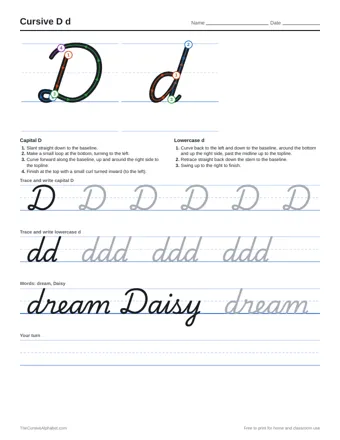
The sheet has the numbered stroke guide for both letters, rows to trace, two practice words and a blank row for writing on your own.