How to write cursive M and m
Capital M is a curl and three slanted stems, with a rounded hump over each. Lowercase m has the same three humps, half as tall. Both end with a tail that joins the next letter.
Capital M
Tall: baseline to topline.
Just below the topline, on the left, with a small curl.
Low on the right, swinging up: the tail reaches a third to half of the way to the midline and runs into the next letter.
Lowercase m
Short: baseline to midline.
About three quarters of the way up to the midline, on the left.
Low on the right, swinging up.
Each hump needs its own stem. The pen retraces the first stem before it starts the second hump, so the retrace is part of the letter, not a mistake. Keep the humps the same width.
Common mistakes with capital M
- The humps are pointed, so the M looks like a print M on a slant.
- The three stems are spaced unevenly or do not share one slant.
- A third hump is added, so the M reads as an M with an extra n.
Common mistakes with lowercase m
- The humps are pointed, so the m looks like a print m or a w upside down.
- A hump is dropped or added, so m and n are confused.
- The first hump is started with an undercurve, so the letter begins like a u.
Joining m to other letters
Practice these pairs until the join feels like one movement.
Print a practice sheet for M and m
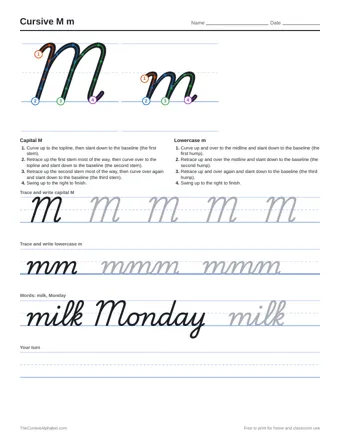
The sheet has the numbered stroke guide for both letters, rows to trace, two practice words and a blank row for writing on your own.