How to write cursive R and r
Capital R is a P with a leg: the bowl ends in a small knot short of the stem, and a leg curves out to the baseline. Lowercase r is a short upstroke to the midline, a small dip, a short stroke to the right, and a slant down.
Capital R
Tall: baseline to topline.
A little above the midline, on the left.
Low on the right, swinging up: the tail reaches a third to half of the way to the midline and runs into the next letter.
Lowercase r
Short: baseline to midline.
At the baseline, on the left.
Low on the right, swinging up.
The lowercase r is the one most adults draw wrong. The pen goes up, makes a small shoulder at the top, and comes down a little to the right of where it went up. Keep the shoulder small.
Common mistakes with capital R
- The bowl is drawn down to the baseline, so the R reads as a B.
- The leg is drawn straight like a print R, so it has no undercurve to join from.
- The retrace leaves the stem, so there are two lines side by side.
Common mistakes with lowercase r
- The shoulder is skipped, so the r reads as an i without a dot or as part of a u.
- The shoulder is drawn as a loop, so the r looks like an e or a small k.
- After a bridge letter the r is started from the baseline, which leaves a gap under the bridge.
Joining r to other letters
Practice these pairs until the join feels like one movement.
Print a practice sheet for R and r
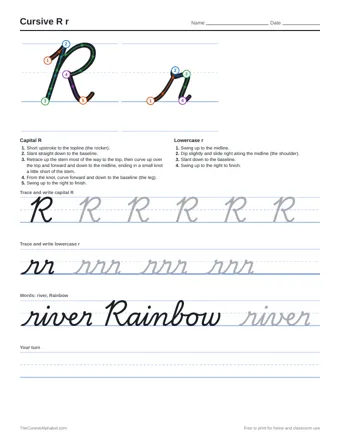
The sheet has the numbered stroke guide for both letters, rows to trace, two practice words and a blank row for writing on your own.