How to write cursive W and w
W is a doubled u. The capital has a curl at the top, then down, up to a lower middle peak, down and up again. The lowercase w starts like a u, but its last stroke swings back up to the midline and ends with a short bridge.
Capital W
Tall: baseline to topline.
Just below the topline, on the left, with a small curl.
At the topline, on the right. The pen lifts; the next letter starts on its own.
Lowercase w
Short: baseline to midline.
At the midline. At the start of a word, many people add a short upstroke from the baseline first.
At the midline, at the top of the last upswing. When a letter follows, a short bridge runs right from here.
Keep the middle peak of the W lower than the two outer tops. Three equal points make the letter look like a row of stems. In the lowercase w, the last stroke stops at the midline and bridges out.
Common mistakes with capital W
- The bottoms are pointed, so the W looks like a print W.
- The W is drawn as two separate V shapes instead of one stroke.
- The letter is drawn wide and flat, out of proportion with the other capitals.
Common mistakes with lowercase w
- The bridge is left out, so the w reads as 'ui' or 'iu'.
- The bottoms are pointed, so the w looks like a print w.
- The bridge sags down toward the baseline.
Joining w to other letters
Capital W lifts before the next letter, so start the second letter fresh. Practice the lowercase pairs until each join feels like one movement.
Print a practice sheet for W and w
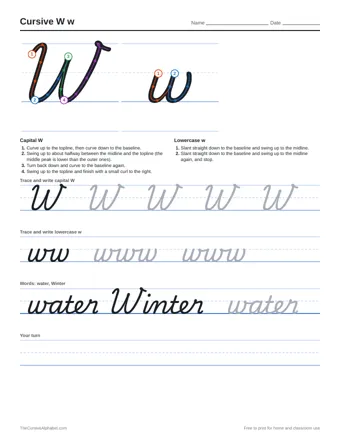
The sheet has the numbered stroke guide for both letters, rows to trace, two practice words and a blank row for writing on your own.