How to write cursive Y and y
Capital Y starts like a U, with a curl, a curve down and up, and then a stem that drops below the baseline and loops under. Lowercase y is a u with a tail: the second stroke keeps going below the line, loops, and comes back up through the baseline.
Capital Y
Tall, with a tail below the baseline.
Just below the topline, on the left, with a small curl.
Low on the right, swinging up: the tail reaches a third to half of the way to the midline and runs into the next letter.
Lowercase y
Short, with a tail below the baseline.
At the midline. At the start of a word, many people add a short upstroke from the baseline first.
Low on the right, swinging up.
The loop under the line turns to the left and comes back up through the baseline to join the next letter. Keep it the same size as the loop on a g or j so the descenders match.
Common mistakes with capital Y
- The stem stops at the baseline, so the Y reads as a U.
- The lower loop is drawn big, or it crosses above the baseline, so the letter sits wrong on the line.
- The two upstrokes are pointed at the bottom, so the top looks like a V.
Common mistakes with lowercase y
- The stem stays above the baseline, so the y reads as a u.
- The lower loop is drawn big or crosses above the baseline.
- The first stroke is closed into an oval, so the y becomes a g.
Joining y to other letters
Practice these pairs until the join feels like one movement.
Print a practice sheet for Y and y
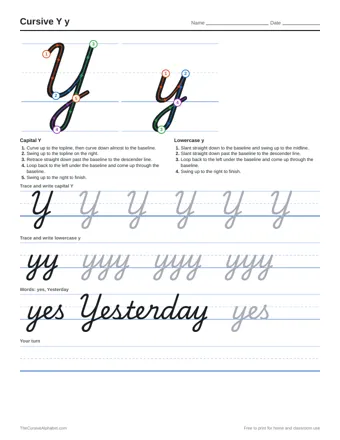
The sheet has the numbered stroke guide for both letters, rows to trace, two practice words and a blank row for writing on your own.