How to read cursive
How to read cursive, from a teacher's note to a letter written in the 1860s: what to look at first, the letters that are easy to mix up, the habits of old handwriting, and real letters to practice on, with a quiz.
Read words, not letters
Cursive is read by shape. Trying to pick out one letter at a time is slow and usually goes wrong, because joined letters lose their edges. Instead:
- Read the easy words first. Short words like the, and, to, of and I give you the writer's letter shapes for free.
- Find the tall and the low letters. The loops above the line (b, d, f, h, k, l, t) and below it (f, g, j, p, q, y, z) give each word an outline you can match.
- Count the strokes. For runs of short letters like m, n, u, w and i, count the downstrokes: m has three, n two, u two.
- Watch the top joins. Only b, o, v and w join the next letter at the top. A join that leaves from the midline tells you one of those four came before it. The guide to how cursive letters join explains all the joins.
- Use the sentence. Read on, then come back. A word that is unreadable on its own is often obvious once you know what the sentence is about.
- Make the writer's alphabet. For a long document, keep a list of how this writer makes each capital and any odd letters. Their habits stay the same from page to page.
Letters that look alike
These are the pairs that trip readers up most often, shown in the cursive used on this site. Handwriting varies, but the differences to look for are the same.
| u n | u or n? A u dips down between its two strokes, like a cup. An n goes up and over, like a hill. Count the humps and look which way they open. |
| m n | m or n? An m has three downstrokes and an n has two. Old writers often skimp on the humps, so count downstrokes rather than humps. |
| e l | e or l? Both are loops. The e only reaches the midline, the l goes all the way up. In fast writing the e can lose its loop and look like an i without a dot. |
| r s | r or s? The r has a small flat shoulder at the top, the s a point with a closed curve below it. At the end of a word both can shrink to a squiggle. |
| b f | b or f? Both start with a tall loop. The b closes with a small bowl that joins at the top; the f carries on below the line into a second loop. |
| v u | v or u? A v ends at the top and hands over to the next letter with a bridge; a u ends low. If the join after it leaves from the top, it is a v. |
| a o | a or o? An a closes its oval and comes down a short stem to the baseline. An o closes and stays at the top. A careless a can look like an o and the other way round. |
| G S | G or S? Cursive capital G and S both start low and loop up, and look nothing like their printed forms. The G has a pointed top before its long curve. |
| Q 2 | Q or 2? Cursive capital Q looks like a 2. In a name or a place it is a Q; in a list of numbers it is a 2. |
| I J | I or J? Capital I and J start the same way. The J drops below the line with a loop; the I stays on the baseline. |
| T F | T or F? Capital T and F share their top stroke. The F has a short crossbar through the stem; the T does not. |
| Z 3 | Z or 3? Cursive capital Z sits on the line with a loop below, and can look like a 3. |
The capitals are the biggest hurdle for people who learned print only. The cursive alphabet chart shows them all side by side, and each letter page has the strokes.
Habits of old handwriting
- Little or no punctuation. Many writers ran sentences together or used a dash for every stop. Read for meaning, not for full stops.
- Spelling by ear. Before spelling was standard in schools, people wrote words as they said them. Say the word out loud.
- Abbreviations. Wm. for William, Jas. for James, Chas. for Charles, Thos. for Thomas, Geo. for George and Jno. for John; &c. for etc.; inst. for this month, ult. for last month and prox. for next month. Raised letters, like a small 'r' after 'Dr', mark a shortened word.
- The long s. Until the early 1800s an s inside a word was often written tall, like an f without a full crossbar, and a double s as long s plus short s, so 'Miss' can read as 'Mifs'.
- Writing in every corner. Paper and postage cost money, so writers filled the margins sideways or turned the sheet and wrote across the first lines (cross-writing). Read one direction at a time.
- Fading. Pencil smudges and iron gall ink turns brown. Zoom in, raise the contrast on a scan, and follow the shape of each word.
Practice on real letters
Abraham Lincoln to his wife, 1860
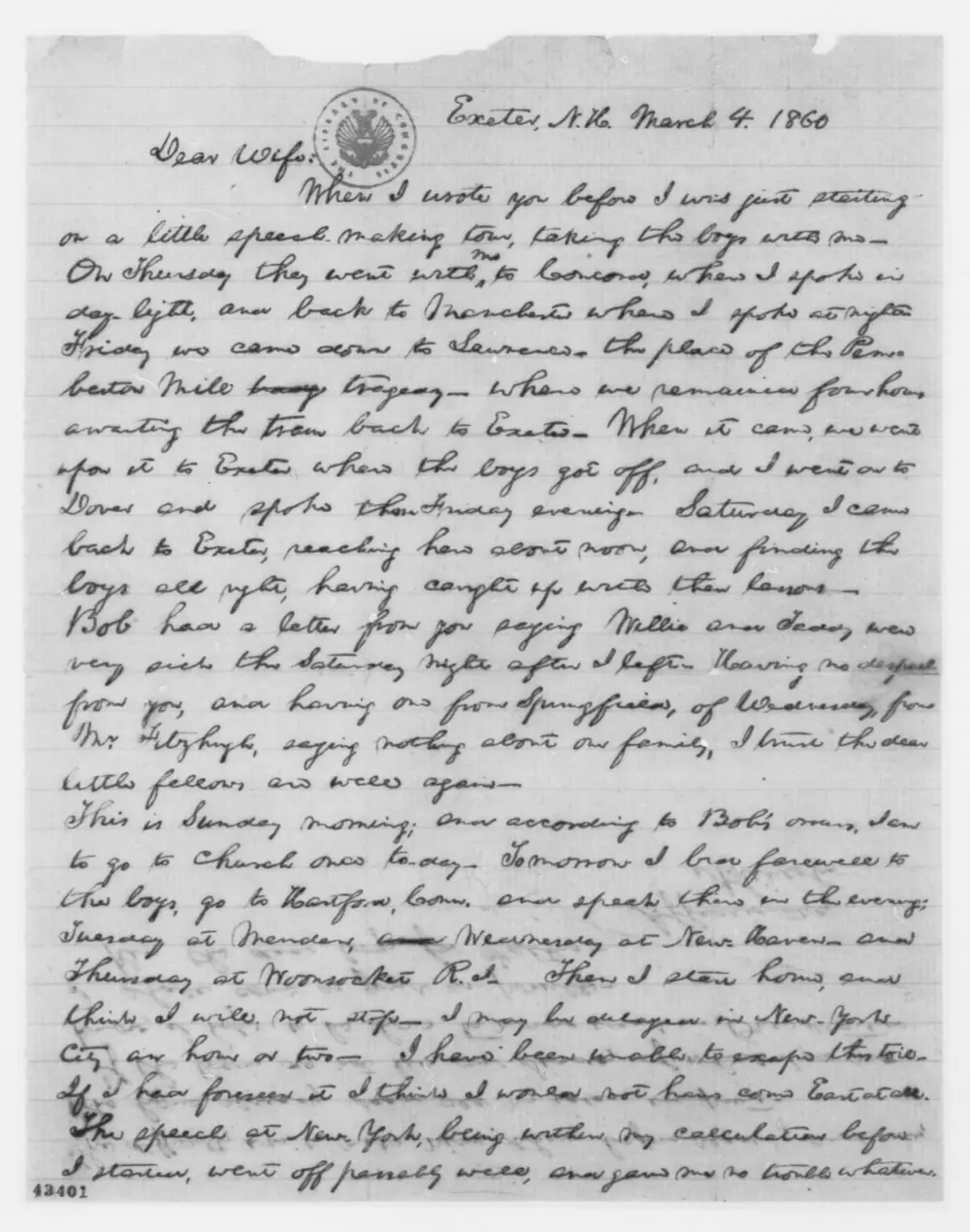
Lincoln wrote fast and plainly, which makes this a good first letter. Try reading the opening before you look at the transcription.
Show the transcription
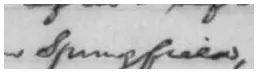
Exeter, N.H. March 4. 1860
Dear Wife:
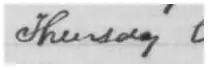
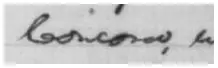
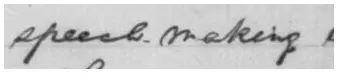
When I wrote you before I was just starting on a little speech-making tour, taking the boys with me. On Thursday they went with me, to Concord, where I spoke in day-light, and back to Manchester where I spoke at night.
Things to notice: the 'me' written above the line with a caret after 'went with'; Lincoln's final d, a small closed loop with no stem, in 'Concord'; and dashes where we would put full stops.
A letter to Josephine, 1862
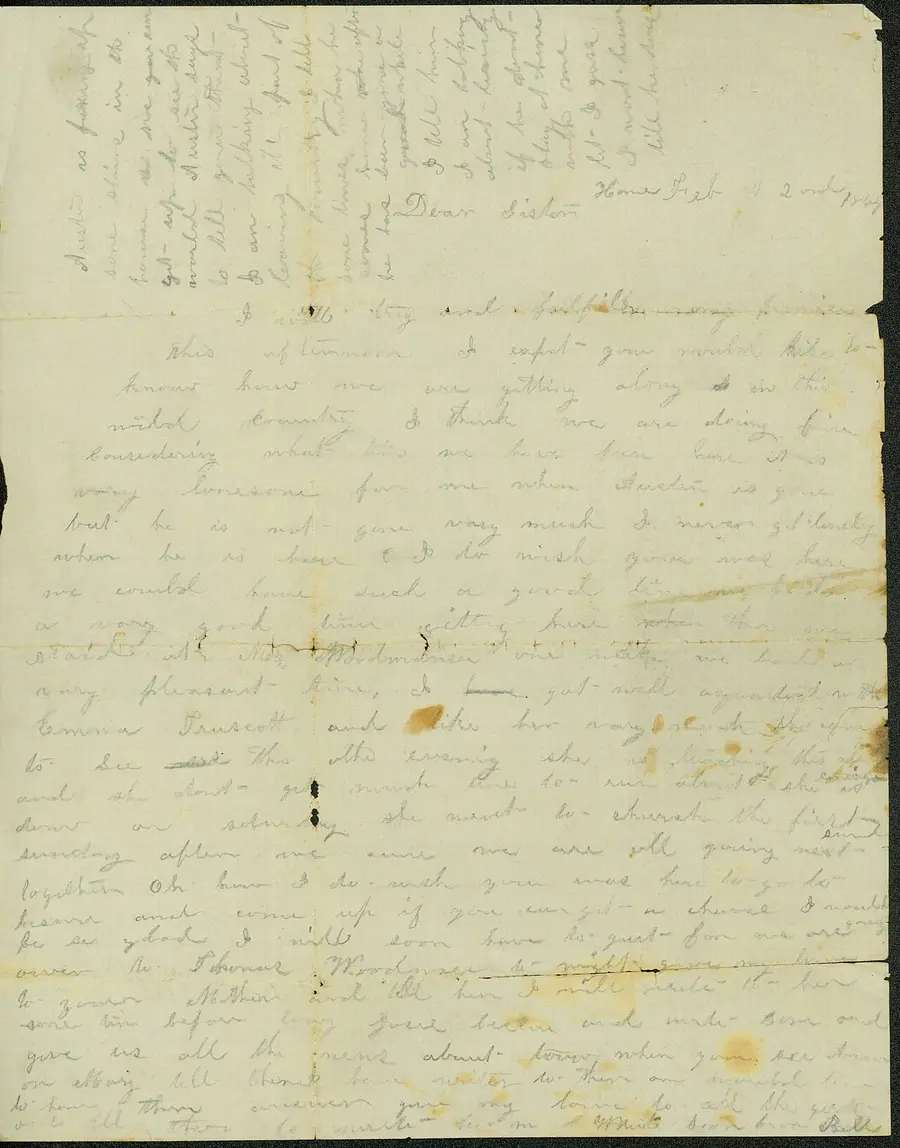
This one is harder: soft pencil, no punctuation, and capitals that are not the ones taught today. Read it a phrase at a time.
Show the transcription
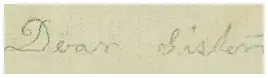
Dear Sister
I will try and fulfill my promise this afternoon. I expect you would like to know how we are getting along in this wild country. I think we are doing fine considering what time we have been here. It is very lonesome for me when Austin is gone but he is not gone very much. I never get lonely when he is here.
The original has almost no punctuation; the full stops are added here to make it easier to follow. Notice the sideways lines in the top left margin, written when the writer ran out of room.
Quiz: read the word
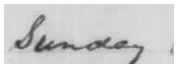
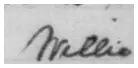
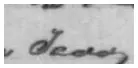
Eleven words cut from the two letters. Pick what each one says.