How to write cursive G and g
Capital G is one of the harder letters: an upstroke into a loop near the top, a rise to the top right, and a long curve that comes back down and across. Lowercase g is an a with a tail, the same oval as a with a loop below the line. There is a second form of the capital G that ends with a shorter last stroke.
Capital G
Tall: baseline to topline.
At the baseline, on the left.
On the right, about a third of the way up. The pen lifts; the next letter starts on its own.
Lowercase g
Short, with a tail below the baseline.
At the midline, on the right side of the oval.
Low on the right, swinging up.
Capital G, second form
The G taught in Zaner-Bloser schools. The first three strokes are the same. Only the ending changes: after the bowl, the last stroke is a short curve to the right inside the letter, not a bar across the whole letter.
At the baseline, on the left.
Inside the letter, about a third of the way up from the baseline. The pen lifts; the next letter starts on its own.
Learn the capital in two halves. First the loop and the rise, then the long curve down. The last stroke slides right about a third of the way up and stops at the right edge of the letter, so it does not run on into a crossbar.
Common mistakes with capital G
- The long curve is stopped at the baseline instead of coming up the left side, so the G falls apart into a 'y' and a bar.
- The final stroke is drawn too long and runs out past the letter, so it reads as a crossbar.
- The top loop is left out, so the first two strokes make a plain V.
Common mistakes with lowercase g
- The oval is not closed, so the g reads as a c with a j after it.
- The lower loop is drawn big or crosses above the baseline.
- The tail stays above the baseline, so the g becomes an a.
Joining g to other letters
Capital G lifts before the next letter, so start the second letter fresh. Practice the lowercase pairs until each join feels like one movement.
Print a practice sheet for G and g
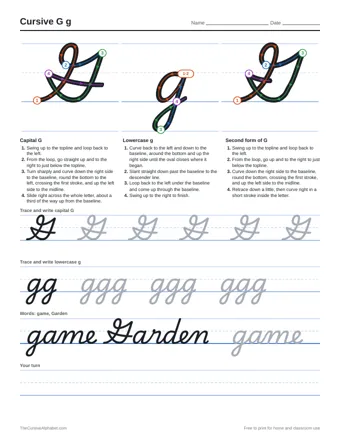
The sheet has the numbered stroke guide for both letters, rows to trace, two practice words and a blank row for writing on your own.